moving forward and beyond
after the jam
ask THESE questions after the jam
- What has changed in our day to day business after your visit?
- In what way are decisions made differently?
- How has our collaboration changed?
- What changes have actually lasted over time?

CONTINUOUS IMPROVEMENTS AND CHANGE
INNOVATION ......
live with change - stay in business
changing business
TIME is relative and perceived as short if the environment is fast changing.
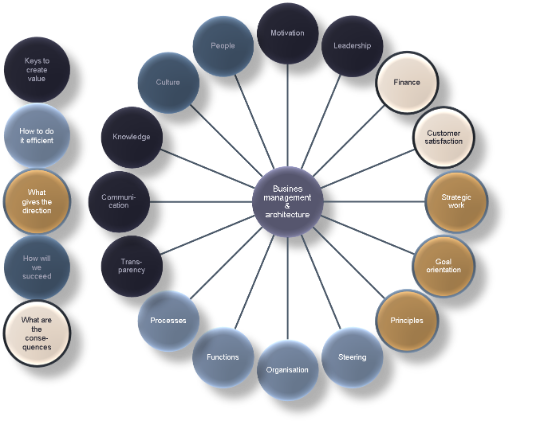
Each business is unique, but is built upon the same core components that supports any business model. In fast changing environment, organisations must change with it.
Control is maintained by active and proactive change, depending on business model.
The stakeholders, the receivers of the products and services delivered, are the ones that decides change pace and so the structure and setup within the business architecture. Stakeholders must constantly be surveyed to detect changed expectations, and thereby defining how flexibility the company must have within and between the architectural components.
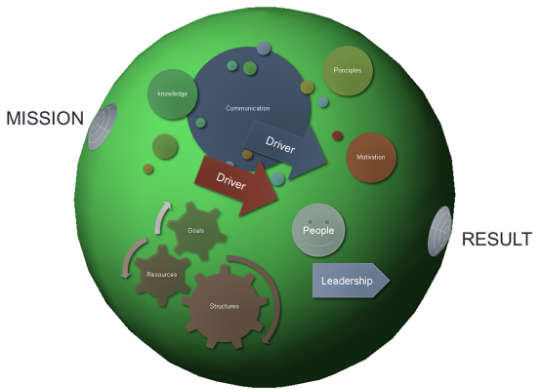
business drivers
The organisational direction defined within strategic work, overall goals striving towards the mission, and the principles on which the company is built upon, should be defined not to be necessary to change often, i.e. must be designed to meet the change pace.
This is closely connected with change management and involves the success factors people and culture, which are slow changing and expensive components within the architectural setup, and most difficult to change.
These in turn are the ones possessing the keys to create value within the organisation, which is motivation, knowledge, leadership, communication and transparency.
Culture must invoke people knowledge on how to do things and why, highly dependent on leadership and communication that should be one of the motivators to do a god job. Transparency is dependent on company size and sets focus on communication extent and model.
The organisational model should suite the size to ease communication, deciding how efficient processes can be conducted. More hierarchical organisation and steering structure means less transparency and if transparency should be kept, and then efficiency, more focus must be set on communication and goal orientation for people to know what to do.
How well the organisation succeed is measured in profitability and customer satisfaction. This can be continuously controlled by KPI measures for the different components in the architecture to detect improvements or deviations, and should be set according to flexibility requirements and change pace.
 .
.